Construction Electrical
Industrial Technology and Trades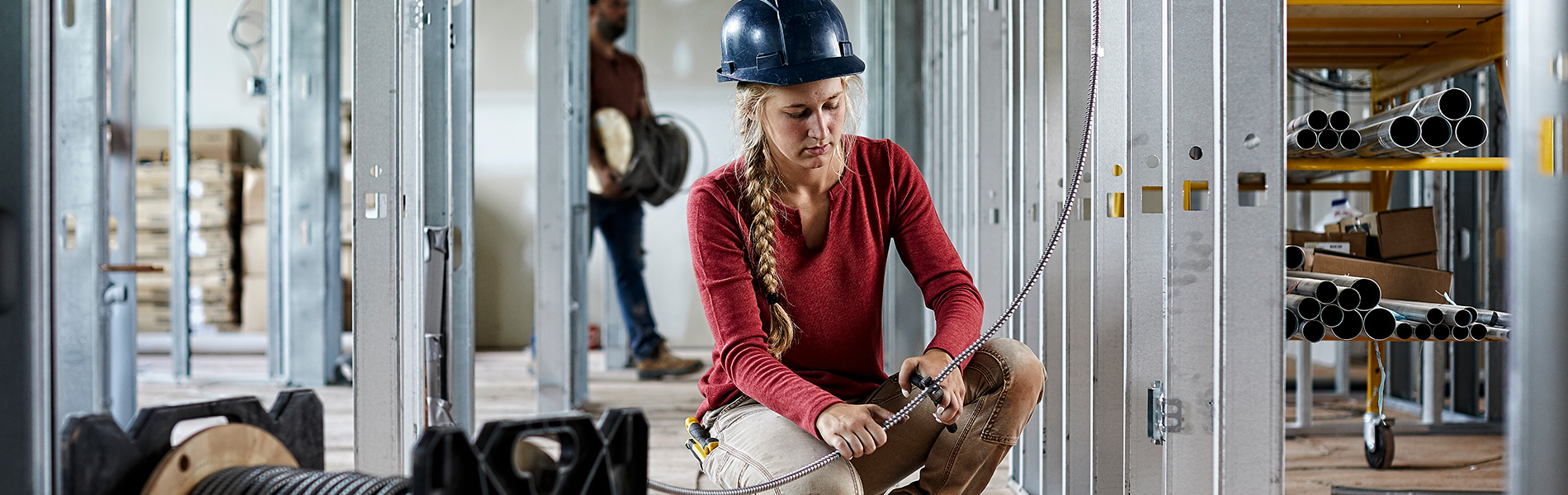
The Construction Electrical program gives you fundamental knowledge about electricity and its applications, and prepares you to work in residential and commercial settings assembling, installing, testing, maintaining, servicing, and operating various electrical systems and equipment.
You will move from the classroom to the lab, getting plenty of experience installing power and lighting systems, emergency lighting, communication equipment, motors, automation and control systems and solar energy systems, as well as learning how to follow the National Building Code, the Canadian Electrical Code, and other safety requirements.
Please note: This program accepts Mature Student applications.
September 2026
Summerside Waterfront Campus
Program Length
1 Year
Credential
Certificate, Construction Electrical
Canadian Tuition
International Tuition
Canadian Applicants
Waiting list
International Applicants with a Valid Study Permit
Waiting list
Other International Applicants
Waiting list
Notes:
Course Code:SAFE-1005
An overview of the Occupational Health and Safety Act of Prince Edward Island. Students examine the legislation, how PEI employees are protected while on the job and the responsibilities of employees and employers.
Credit Value:0
Course Code:BLPR-1010
The ability to read and understand blueprints is essential in the construction field, as blueprints are used to design, plan, estimate and build projects. This course introduces students to blueprint reading and sketching, with a focus on engineered drawings for residential and commercial types of structures.
Credit Value:2
Course Code:COMM-1005
This course is designed to allow students to develop preparatory skills for securing and retaining employment including; workplace communication, time management, critical thinking and problem-solving, and customer service. Upon successful completion of this course students are able to use oral communications techniques, and create a variety of written documents and reports used in the workplace. Methods and strategies for job search, preparation and retention are also incorporated.
Credit Value:3
Course Code:COMP-1000
Students learn productivity software and explore digital environments with practical applications for various workplaces and educational institutions. The main areas of focus include word processing, spreadsheets, presentation software, email and other electronic communication tools, various digital environments, and industry-specific applications.
Credit Value:3
Course Code:ELEC-1001
Students learn safe working practices and measures to ensure both personal and public safety as it pertains to the electrical trade. Students also learn about the Canadian Electrical Code (CEC), how to utilize this standard, and how it applies to electrical installations that they will encounter in the program, and throughout their careers.
Credit Value:3
Course Code:ELEC-1021
The installation and maintenance of electrical equipment requires an understanding of electrical characteristics in order to properly install and troubleshoot equipment in a safe and professional manner. This course provides students with the basic theory required to solve and analyze DC circuits. Lab time is used to reinforce theory.
Credit Value:3
Course Code:ELEC-1026
In this course students learn the fundamentals of alternating current (AC) which provides a foundation for future studies in transformers, rotating machines and transmission of electrical energy.
Credit Value:3
Course Code:ELEC-1040
In this course students learn the practical skills required for residential installations. Students become more familiar with the Canadian Electrical Code (CEC) by ensuring that all installations are in compliance.
Credit Value:3
Course Code:ELEC-1045
In this course students learn the practical skills required to perform commercial/industrial installations. The course focusses on the proper selection and installation of conduit, tubing and cables and the wiring methods employed with this type of installation. Compliance with the Canadian Electrical Code (CEC) is stressed for all installations.
Credit Value:3
Course Code:ELEC-1050
This course introduces the theory of three-phase circuits, as well as single-phase and three-phase transformers and their applications in residential, commercial, and industrial wiring. The advantages of a three-phase system are discussed, as well as the concepts of operation of isolation, autotransformer and instrument transformers. Emphasis is placed on The Canadian Electrical Code as it is used for the sizing of conductors and overcurrent devices used in transformer circuits. Lab activities are used to reinforce theory.
Credit Value:4
Course Code:ELEC-1057
In this course students learn about the various types, designs, and applications of three wire distribution systems and electrical conductors. Students explore internal and external variables that limit a conductor's ability to conduct electricity. Students perform calculations of a conductor's performance in the presence of certain variables, using the Canadian Electrical Code (CEC) as a guide. .
Credit Value:4
Course Code:ELEC-1070
Students apply the practical skills required for residential installations. Students continue to become familiar with the Canadian Electrical Code (CEC) by ensuring all installations are in compliance. Students are also provided with the knowledge and skills necessary to understand the basics of communication systems, their installation procedures and troubleshooting techniques for premise cable installations.
Credit Value:2
Course Code:ELEC-1160
This course introduces the theory of DC and AC rotating machines and their basic control, with focus on the proper identification of the machine as well as the wiring connections and control methods. As part of this course, students are given the opportunity to demonstrate motor wiring skills in a practical workshop environment.
Credit Value:4
Course Code:ELEC-2140
This course provides an overview of the various building electrical systems that electricians typically encounter in both residential and commercial settings. Systems explored include building lighting systems, heating, ventilation and air conditioning (HVAC), solar photovoltaic systems, as well as standby and backup systems. Students gain an understanding of the electrical characteristics of these systems in order to properly install and troubleshoot equipment in a safe and proficient manner.
Credit Value:3
Course Code:MATH-1060
This course is designed to enable the student to develop trade related math skills. Students acquire competency in the math skills as they relate to their Electrical Construction Wiring trade and future career. Emphasis is placed on developing problem solving and critical thinking skills used in trouble-shooting. Students are challenged to continually make connections between math and the electrical field, as well as every day applications.
Credit Value:3
Course Code:MATH-1160
Building on the skills developed in Electrical Trade Math I, students continue to develop their trade math skills focusing on solving problems involving linear measurement, as well as problems involving area and volume using both the Metric and Imperial measurement systems. Conversions between systems are also discussed, as well as solving trade related problems involving percentages and discounts.
Credit Value:2
Course Code:NCPR-1001
A comprehensive two-day course offering standard first aid and cardiopulmonary resuscitation (CPR) skills from a certified trainer. As required by regulation, this course covers CPR and the management of other breathing, airway and circulation emergencies, as well as, the control of bleeding, treating shock, stabilizing fractures and dislocations, head and spine injuries, and more. Also, includes automated external defibrilators (AED). This certification expires in 3 years.
Credit Value:0
Course Code:NCPR-1002
Students complete Workplace Hazardous Materials Information System (WHMIS) training and certification.
Credit Value:0
Course Code:NCPR-1066
Students are trained and become certified in the application and use of fall protection equipment. Students explore hazards, legislative requirements, as well as various types of fall protection systems and their components. Demonstration of the proper application and use of fall protection is required in order to pass this course.
Credit Value:0
Course Code:NCPR-1068
Students acquire knowledge, demonstrate proficiency, and become certified in the safe use of elevated work platforms. Please note that Certified Fall Protection training is a pre-requisite for this course, and students are expected to supply their own personal protective equipment, including hard hat, eye protection, and steel toed footwear.
Credit Value:0
Upon successful completion of the program, graduates will be able to:
The most successful path to a Red Seal as a construction electrician begins with the Construction Electrical program. This program enables you to earn 30 hours of apprenticeship time for each week of training and write the apprenticeship year-one block exam, which puts you well on your way to Red Seal certification.
Upon graduation, once you are working with a suitable employer, you will register as an apprentice to complete your journey to challenge the Red Seal exam. When you register, Apprenticeship PEI will give you credit for the hours earned and block exams passed while you were at Holland College.
The Red Seal gives you the ability to work anywhere in Canada without further testing or certification.

The program has a great curriculum, and the instructors are knowledgeable and give timely feedback. The resources available are reasonable and offer an opportunity to learn and develop skills.
Graduating Student Survey Respondent, Class of 2024
Learn how to plan, install, test, inspect, troubleshoot, and service all types of industrial electrical equipment.
Earn your diploma in Electromechanical Technology and learn to repair hydraulic/pneumatic systems, programmable logic controllers, microprocessors and more.