Conservation Enforcement
Atlantic Police Academy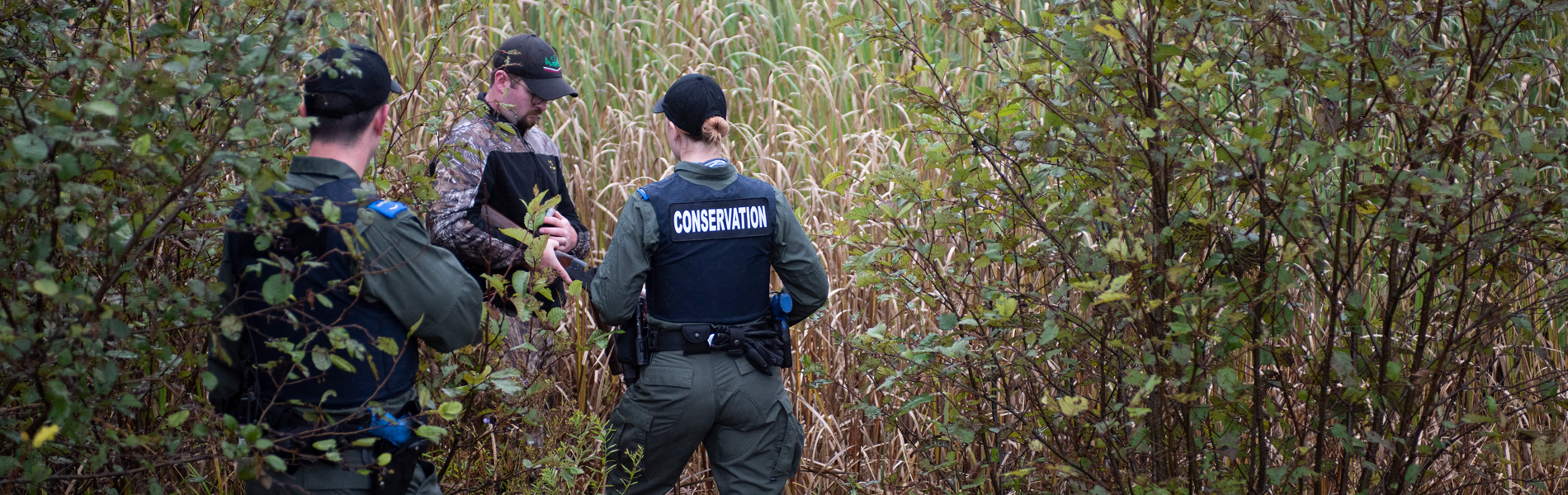
Prepare to work in natural resource agencies as a conservation enforcement officer and in other related fields of enforcement and security throughout Canada.
In this program, you will take courses in topics such as conservation investigations, defensive driving and traffic control, national use of force framework, scenario/reality-based training, and professional patrol tactics. After completing on-the-job training, you will be prepared to work in natural resource agencies as a conservation enforcement officer and in other related fields of enforcement and security throughout Canada.
You will live in our Slemon Park residence for the duration of your program, except when you are away for on-the-job training.
August 2026
Atlantic Police Academy
Program Length
18 Weeks
Credential
Certificate, Conservation Enforcement Officer
Canadian Tuition
Canadian Applicants
Waiting list
International Applicants with a Valid Study Permit
Not Accepting Applications
Other International Applicants
Not Accepting Applications
Proof of Canadian citizenship or Canadian permanent resident status
Grade 12 or equivalent with credits at or above the general level
Minimum one year of post-secondary education*
19 years of age by program start date
Successful completion of the Minnesota Multiphasic Personality Inventory. The applicant is responsible for this cost. This test will be arranged by Holland College Admissions for those in the Maritime Provinces.The purpose of psychological testing is to assure the applicant's suitability to participate as a cadet at Holland College's Atlantic Police Academy. Although the process may be similar to screening for employment, that is not an objective nor the purpose of this testing. Employers are encouraged to undertake further testing and background checks to ensure candidates' suitability for employment. Note: It is the responsibility of applicants who reside outside of the Maritime provinces to arrange for MMPI testing in their region. Testing for applicants who reside within the Maritime provinces takes place in P.E.I., and applicants are expected to be present for the date of their testing
Successful completion of Physical Ability Requirement Evaluation Test (PARE). This is a PDF and will open in a new window.
Completion of an APA Medical Assessment Form (this is a PDF and opens in a new window)
Criminal Record Check (Vulnerable Sector) with no findings of guilt. Find out more about Criminal Record Checks.
Successful completion of a full background check. Please download and complete the Consent to Criminal Record and Background Check form. This form is a PDF and will open in a new window.
Valid Class 5 (cars and light trucks) driver’s license (students holding restricted or graduated licenses must abide by the conditions of the license)
Three letters of reference, not from family members
Completion of Immunization Verification Form (this is a PDF and will open in a new window) (required after acceptance)
Certification in swimming – “Swim to Survive” or equivalent
Standard First Aid, CPR Level C and Automated External Defibrillator (AED) must be valid for the duration of the program. View a list of providers here. This training must be taken in person, NOT online.
Pleasure Craft Operator Card
All-Terrain Vehicle (ATV) safety training course from a certified trainer
Résumé including work and volunteer experience with applicable dates, membership in groups, associations or athletics, awards and distinctions, and any other information about yourself relevant to the program including work and volunteer experience with applicable dates, membership in groups, associations or athletics, awards and distinctions, and any other information about yourself relevant to the program
*Preference is given to candidates who are qualified Forestry, Wildlife, Fishery, or Environmental Technicians or graduates of a renewable resource program. Completion of a two-year diploma in one of these areas is a requirement for employment in New Brunswick, Nova Scotia, and Prince Edward Island.If you do not have a two-year diploma in one of these areas, your employment options may be limited.
This program has degree pathways, giving you the opportunity to receive credit for your Holland College diploma when you continue your education. For a complete list of agreements, visit the Degree Pathways page.
| Partner Institution | Credential | Details of Agreement |
|---|---|---|
| Columbia Southern University | Bachelor of Science in Criminal Justice Administration | Graduates receive 24 credits toward a Bachelor of Science in Criminal Justice Administration degree. |
Course Code:SAFE-1005
An overview of the Occupational Health and Safety Act of Prince Edward Island. Students examine the legislation, how PEI employees are protected while on the job and the responsibilities of employees and employers.
Credit Value:0
Course Code:CONENF-1005
This course consists of specialized firearms safety, marksmanship and tactics. At the end of this course students will be skilled in firearms safety and will be prepared to use a variety of firearms (9mm handgun and 12 GA. shotgun) in various situations.
Credit Value:4
Course Code:CONENF-1010
This course will examine various pieces of Federal and Provincial Legislation and Regulation. This examination will enable students to navigate through Legislation and Regulation that relate to the execution of their duties as a Conservation Officer. Students will understand how to apply the powers given to them under these Acts and will become familiar with specific case law that impacts Conservation Enforcement.
Credit Value:2
Course Code:CONENF-1015
This course is an introduction to the Criminal Code and prepares Conservation Officers to effectively use the parts of the Criminal Code that apply to their work. Students discuss and explore legal topics that relate directly to their work as Conservation Officers. The topics to be covered include legal terminology, Powers of Arrest, search and seizure, the Charter, disclosure, case citation, warrants and statements. Case law regarding these issues are discussed. Through a mock course exercise, students experience acting as a crown witness and compelling a subject to appear in court.
Credit Value:2
Course Code:CONENF-1020
This course will prepare students to conduct conservation enforcement investigations. Through a variety of delivery methods students will learn and practice sound investigative procedures. Students will focus on effective note taking practices, investigative report writing, information/evidence gathering, and practical skills applications.
Credit Value:2
Course Code:CONENF-1030
This course examines the different types of conservation enforcement compliance patrols and the factors that must be considered when choosing the appropriate patrol type. Students learn to utilize information to plan an efficient and effective compliance patrol. This course also enables the student to effectively use the mobile communication system.
Credit Value:2
Course Code:CONENF-1035
In this course, students examine communication, including types, barriers, as well as skills and strategies for effective communication and de-escalation. Students gain an awareness of mental disorders and cultural diversity, and their potential impact on human relations.
Credit Value:2
Course Code:CONENF-1040
This course is designed to prepare students for the rigors of the Conservation Officer profession and the various physical tests that conservation departments require of their officers and applicants. This course encourages and challenges students to improve their fitness level through fitness programming and nutrition.
Credit Value:1
Course Code:CONENF-1046
This course provides the student with enhanced driving skills to assist them in their work and everyday driving. Students complete the driving course which covers defensive driving skills, controlled responses, skid control techniques, and emergency stopping techniques. Additionally, students learn to secure and maneuver trailers safely and efficiently. Students are also shown the prescribed method for directing traffic (vehicle and pedestrian), and performing vehicle stops. Students practice these skills on the driving track to industry standards.
Credit Value:2
Course Code:CONENF-1053
This course introduces students to the professional tactics and intervention measures used to control situations encountered by conservation officers, with an emphasis on officer and public safety. Conservation officers are expected to both verbally and physically intervene and control the outcome of a variety of situations. In this course, students demonstrate proficiency in the application of their intervention, defusing, and situation control skills by implementing various aspects of a current use of force model. Students practice using the appropriate verbal requests, directions, commands, techniques, equipment, and weapons during the various interventions.
Credit Value:6
Course Code:CONENF-1055
This course is designed to increase officer safety as well as the ability of an officer to respond appropriately to specific threats, including lethal force. This course helps to develop decision-making skills along with the ability to effectively respond to threats, including those that are likely to cause bodily harm or death to those involved.
Credit Value:1
Course Code:CONENF-1060
On the Job Training provides the opportunity for the student to be involved in all aspects of the conservation enforcement field. The student officer works under the supervision of a training officer and is involved in regular duties with that officer. As the training officer observes the student's performance in a variety of real world situations, observed competencies are measured and evaluated.
Credit Value:6
Course Code:CRES-1000
Participants learn to use the Crisis Intervention and De-escalation (CID) Model and apply techniques to effectively de-escalate crisis situations, specifically those incidents involving intervention in a mental health crisis. This blended course consists of online learning activities through the Canadian Police Knowledge Network (CPKN), classroom training, as well as scenario based training.
Credit Value:1
Course Code:NCPR-1002
Students complete Workplace Hazardous Materials Information System (WHMIS) training and certification.
Credit Value:0
Course Code:PROF-1050
The purpose of this course is to examine and practice ethical and professional behaviors to prepare students for making ethical choices during their time at the academy and in their professional public safety careers. Students are required to produce and follow a personal code of ethics, work as a team, and to exhibit behaviors and values that are consistent with the expectations of the profession and the public.
Credit Value:1
Upon successful completion of the program, graduates will be able to:
You must be a Canadian citizen or have Canadian permanent resident status to apply for this program.
Conservation Enforcement students are required to live in residence for the duration of their training, except when they are in on-the-job training.
Are you physically ready for this program?
In this video, Coach Corey Arsenault tells you what to expect and how to prepare before you get here!
English version / Version française
Provincial and federal conservation wildlife and parks enforcement authorities.

[An] excellent program which provided us with a superior level of knowledge to be able to start a job in this field with confidence that we could handle ourselves professionally and be able to contribute something to the team we were joining. The instructors all had years of background in the subjects that they were teaching us and were eager to pass along this knowledge to those who showed an interest.
Graduating Student Survey Respondent, Class of 2024
Start your career as a Wildlife Technician! Learn to collect samples, conduct experiments, & prepare reports in the Wildlife Conservation Technology Program.
Study Police Science at The Atlantic Police Academy and learn the academic and tactical skills required to work as a Police Officer in Canada.