Aircraft Turbine Technician
Industrial Technology and Trades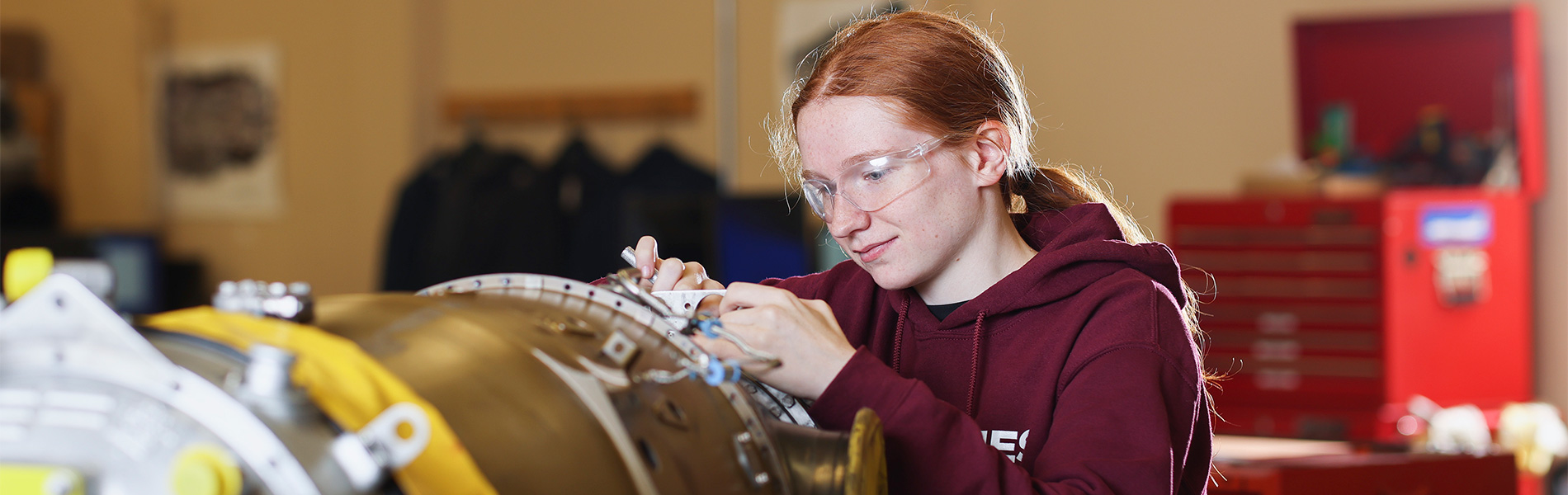
Aircraft turbine technicians inspect and troubleshoot issues with aircraft engines and mechanical systems, and modify, repair, and overhaul turbine engines.
You will learn the techniques, procedures, and documentation requirements you need to work in the growing Aerospace industry. Students train on a Pratt & Whitney PT6A-20 turboprop engine. Depending on your lab progress, you may also train on the Pratt & Whitney PW100 turboprop engine or the Rolls Royce 250 turboshaft engine, or both. If you are looking for a mechanical and detail-oriented, hands-on career in a fast-paced industry, the Aircraft Turbine Technician program is for you!
This program is located at our Summerside Waterfront Campus. Take a virtual tour.
September 2026
Summerside Waterfront Campus
Program Length
1 Year
Credential
Certificate, Aircraft Turbine Technician
Canadian Tuition
International Tuition
Canadian Applicants
Waiting list
International Applicants with a Valid Study Permit
Waiting list
Other International Applicants
Waiting list
Notes:
Course Code:SAFE-1005
An overview of the Occupational Health and Safety Act of Prince Edward Island. Students examine the legislation, how PEI employees are protected while on the job and the responsibilities of employees and employers.
Credit Value:0
Course Code:COMM-1005
This course is designed to allow students to develop preparatory skills for securing and retaining employment including; workplace communication, time management, critical thinking and problem-solving, and customer service. Upon successful completion of this course students are able to use oral communications techniques, and create a variety of written documents and reports used in the workplace. Methods and strategies for job search, preparation and retention are also incorporated.
Credit Value:3
Course Code:COMP-1000
Students learn productivity software and explore digital environments with practical applications for various workplaces and educational institutions. The main areas of focus include word processing, spreadsheets, presentation software, email and other electronic communication tools, various digital environments, and industry-specific applications.
Credit Value:3
Course Code:GTET-1000
An introduction to the field of repairing and overhauling gas turbine engines. Students learn to safely and efficiently operate and maintain common hand, power, and measuring tools of the trade. As well, students examine processes of preparing an engine for shipping and storage, and the operation of lifting and handling equipment with an emphasis on safety and procedures designed to eliminate component damage.
Credit Value:4
Course Code:GTET-1100
An introduction to the operation of gas turbine engines including: design and construction; familiarization with various engines; inspection, maintenance and overhaul; and fuel systems. Emphasis is placed on the purpose of these parts and systems, how the part or system accomplishes its purpose and how the parts or systems relate to one another.
Credit Value:3
Course Code:GTET-1105
An introduction to the knowledge and processes required to overhaul engines. Students examine the established standards, reference materials and proper documenting procedures, the established procedures to induct the engine into the overhaul facility, how to perform engine stripping and disassembly, and the process of sorting and inspecting parts.
Credit Value:3
Course Code:GTET-1110
An introduction to the practical skills and processes required to overhaul engines. Students apply the established standards, use reference materials and proper documenting procedures, apply the established procedures to induct the engine into the overhaul facility, perform engine stripping and disassembly, and sort and inspect parts.
Credit Value:5
Course Code:GTET-1200
Building on knowledge gained in an earlier course, this course consists of lubrication systems, gears and bearings, anit-ice and ignition systems, anit-stall and starter systems, and propeller systems. An emphasis is placed on the purpose of each part and system, how the part or system accomplishes its purpose and how the parts or systems relate to one another.
Credit Value:3
Course Code:GTET-1205
This course introduces students to the knowledge of: engine assembly; engine testing; the work standards for recognizing damanage, repair, and maintenance of engines; and how non-destructive inspection (NDI) is carried out. Students learn about the steps and procedure documents to organize and record parts, assemble the parts into modules, rework as necessary, balance rotating assemblies, assemble the modules, install external components and inspect the assembled engine for completeness and conformity to standards. They also learn the procedures to prepare the engine for testing, conduct pre-run safety inspections, test the engine, and completing the appropriate documentation.
Credit Value:2
Course Code:GTET-1210
This course introduces students to the skills of: engine assembly; engine testing; the work standards for recognizing damage, repair, and maintenance of engines; and how non-destructive inspection (NDI) is carried out. Students organize and record parts, assemble the parts into modules, rework as necessary, balance rotating assemblies, assemble the modules, install external components and inspect the assembled engine for completeness and conformity to standards. They also prepare the engine for testing, conduct pre-run safety inspections, test the engine, and complete the appropriate documentation.
Credit Value:6
Course Code:GTET-1300
This course examines basic electrical theory and applies it to engine operation. As well, students learn geometric dimensions and tolerancing, especially in relation to service bulletins and engine maintenance.
Credit Value:2
Course Code:MATH-1150
This course is designed to enable the student to develop trade related math skills. Students acquire competency in math skills as they relate to their program and future career. Emphasis is placed on developing problem solving and critical thinking skills used in trouble-shooting. Students are challenged to continually make connections between math and the aircraft technician field, as well as every day applications.
Credit Value:3
Course Code:NCPR-1001
A comprehensive two-day course offering standard first aid and cardiopulmonary resuscitation (CPR) skills from a certified trainer. As required by regulation, this course covers CPR and the management of other breathing, airway and circulation emergencies, as well as, the control of bleeding, treating shock, stabilizing fractures and dislocations, head and spine injuries, and more. Also, includes automated external defibrilators (AED). This certification expires in 3 years.
Credit Value:0
Course Code:NCPR-1002
Students complete Workplace Hazardous Materials Information System (WHMIS) training and certification.
Credit Value:0
Course Code:PHYS-1000
This course is designed to introduce students to mechanical physics. Topics in this course include kinematics, statics, energy, states of matter and waves. Emphasis is placed on developing problem-solving and critical thinking skills as the students relate the physics' concepts to their program of study and their future career.
Credit Value:3
Course Code:PRAC-1341
Students gain industry experience and apply skills and knowledge gained during the preceding courses.
Credit Value:3
Upon successful completion of the program, graduates will be able to:

Great instructors, very engaging and supportive to one's progress and success.
Graduating Student Survey Respondent, Class of 2024
The Automotive Technology program provides a comprehensive introduction to the mechanical and technological skills you’ll need to work as an automotive service technician.
As a Precision Machinist, you could create something that could become an integral part of an airplane or car, a piece of surgical equipment, or a major industrial machine.