Construction Technology and Management
Industrial Technology and Trades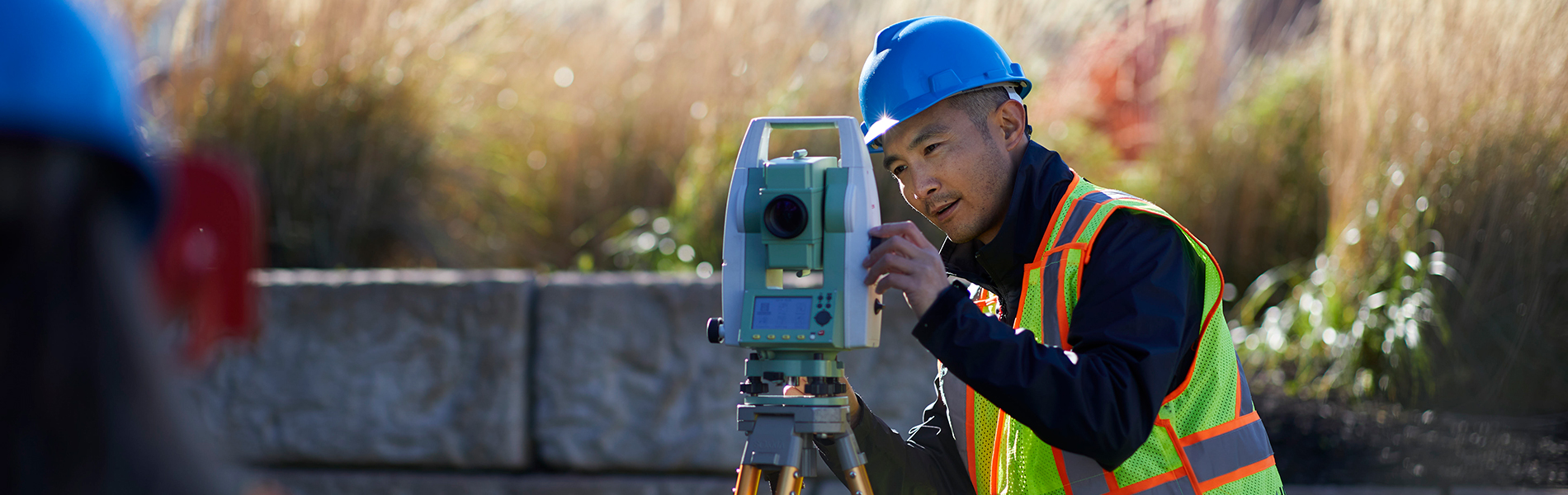
In the Construction Technology and Management program, you will learn how to plan, coordinate, and manage construction projects from inception to completion.
Learn about building materials, drawings and specifications, and the construction process. Develop practical skills by preparing estimates of the cost of materials, labour, site overhead, and start-up costs for residential and commercial construction projects.
You will also visit construction sites and take courses in construction law and contract documents, AutoCAD, and construction surveying. Gain real-life experience in the construction industry and build your network while you complete your on-job training. By the time you graduate, you will be ready to start your career at an administrative or middle management level.
This site is protected by reCAPTCHA and the Google Privacy Policy and Terms of Service apply.
Thank you for reaching out!
Your information has been submitted successfully. A member of our team will be in touch with you soon.
September 2027
Prince of Wales Campus
Program Length
2 Years
Credential
Diploma, Construction Technology and Management
Canadian Tuition
International Tuition
Canadian Applicants
Accepting Applications
International Applicants with a Valid Study Permit
Accepting Applications
Other International Applicants
Accepting Applications
Notes:
This program has degree pathways, giving you the opportunity to receive credit for your Holland College diploma when you continue your education. For a complete list of agreements, visit the Degree Pathways page.
| Partner Institution | Credential | Details of Agreement |
|---|---|---|
| University of New Brunswick - Saint John | Bachelor of Applied Management | Graduates with a 70% average are granted two years of credit toward a Bachelor of Applied Management degree. |
SAFE-1005
An overview of the Occupational Health and Safety Act...
0
CADD-1110
An introduction to basic terminology, concepts, and functions of CAD software to produce technical drawings. Students set up and manage an electronic filing system and manipulate the software to produce technical drawings.
2.00
COMM-1000
An introduction to learning the written and oral communication of technical information. Students research, assemble and present technical information while analysing optimum mediums for industry-specific communication.
3.00
COMP-1000
Students learn productivity software and explore digital environments with practical applications for various workplaces and educational institutions. The main areas of focus include word processing, spreadsheets, presentation software, email and other electronic communication tools, various digital environments, and industry-specific applications.
3.00
CONS-1100
An examination of municipal, provincial, and national codes, standards, acts and regulations that apply to all phases of construction. In response to specific questions and situations, students will locate and interpret information from this "regulatory environment" including the National Building Code of Canada, Canadian Electrical Code, P.E.I. Waste Management Regulations, P.E.I. Employment Standards Act, and many other regulatory documents.
3.00
CONS-1200
An overview of testing procedures for soils, asphalt, and concrete. Students conduct field and lab testing to monitor quality of placement and adherence of mix designs to specification parameters. Students assist in the design of concrete and asphalt mixes that are prepared and tested in a laboratory setting.
4.00
CONS-1210
An introduction to estimating techniques used for residential construction. Students determine the cost of building materials, labour, site overhead, and start-up costs associated with residential construction. Manual calculation techniques are first employed to calculate the total square foot cost. Students also create an electronic estimating tool to use in future estimating projects.
3.00
CONS-1220
A study of building materials used in residential building construction. Students examine construction materials and uses for residential structures including wood and plastics. Plumbing, HVAC, and electrical components for residential construction are also studied. Students visit local construction sites to view the installation and application of these materials.
3.00
CONS-1234
A complete overview of tools and equipment used in construction projects. Students select tools and equipment required to complete a construction project from start to finish including hand tools & power tools.
1.00
CONS-1238
A complete overview of equipment used in construction projects. Students select equipment required to complete a construction project from start to finish including light and heavy equipment.
2.00
CONS-2120
A study of building materials used in commercial building construction. Students examine construction materials and practices for commercial structures including concrete, masonry, wood, plastics, asphalt, and steel. Students visit local construction sites, hardware stores and attend industry semiars to view the installation and application of these materials.
3.00
CONS-2150
Exploration of construction law and contract documents. Students differentiate various types of contracts, interpret civil laws and legislation, and explore related ethical issues. Bonding and insurance issues, tender forms, change orders, addenda, pre-qualification documents, mechanic's lien, and statutory declaration documents are also studied.
3.00
CONS-2200
Students develop and apply methods for monitoring project costs, progress, and inventory. Record keeping, report writing and interpersonal skills development are an integral part of this course.
3.00
CONS-2210
Students determine the cost of building materials, labour, site overhead, and start-up costs associated with commercial construction. Manual and computerized calculation techniques are employed.
3.00
CONS-2220
The study of how to conduct on-site inspections to maintain quality and productivity on a construction site. Students plan and conduct construction site inspections to maintain quality and ensure compliance with drawings and specifications. Planning the use of tools, equipment, and site services is also explored.
3.00
CONS-2240
Students interpret architectural, civil, structural, mechanical, and electrical drawings to identify required materials and components for a commercial construction project.
3.00
MATH-1030
MATH-1030 is a 60-hour college-level technical mathematics course offered to all Technician and Technologist students enrolled in the Engineering Technology programs. The course begins with an intensive overview of measurement, emphasizing both metric and imperial units, conversion of both simple and derived units, and proper treatment of significant digits. Following a review of algebra (including many scientific calculator functions), you will apply skills to solve systems of two and three linear equations by means of graphic, algebraic, and determinant methods; derive and graph functions; and apply factoring to solve fractional and quadratic equations. You will make extensive use of trigonometric and vector analysis to solve technical problems in right and oblique triangles, and angles in any quadrant. You will apply the relationship between exponents and radicals, and the relationship between exponential and logarithmic functions to technical applications. Finally, you will solve problems involving both Euclidean and analytic geometry.
4.00
NCPR-1001
A comprehensive two-day course offering standard first aid and cardiopulmonary resuscitation (CPR) skills from a certified trainer. As required by regulation, this course covers CPR and the management of other breathing, airway and circulation emergencies, as well as, the control of bleeding, treating shock, stabilizing fractures and dislocations, head and spine injuries, and more. Also, includes automated external defibrilators (AED). This certification expires in 3 years.
0.00
NCPR-1002
Students complete Workplace Hazardous Materials Information System (WHMIS) training and certification.
0.00
NCPR-1003
Students learn about asbestos containing materials in buildings, mould awareness and how moisture affects mould growth, lead containing materials in buildings, mercury and PCBS in buildings, radon.
0.00
NCPR-1060
A study of the provincial Occupational Health and Safety Act requirements for Fall Arrest systems within the province of Prince Edward Island.
0.00
PHYS-1200
An examination of general physics topics. Students study vectors, forces in equilibrium, torque and rotation, kinematics, Newton's laws, work, power, fluid and thermal physics, waves, sound, and light.
3.00
PHYS-2100
Examines the basis for structural design applications. Emphasis is placed on problem solving involving the geometric properties of structural shapes, including centroids, moment of inertia, and modulus of elasticity. Vector analysis, resolution of bodies in equilibrium, method of joints/method of sections truss analysis, and stress-strain relationships are also topics that are covered within the scope of this course.
3.00
PHYS-2200
An introduction to structures used in construction. Students design structural members and calculate live and dead loads. Students also analyze imposed loading and select components through the limit states design process. A structural drawing comprised of a plan view, cross sections, and connection details is created based on the analysis and selection of structural members.
3.00
PRAC-2160
Students apply theoretical and practical skills in the field under direct supervision. Exposure to and interaction with the various trades and professions within the field of construction provides the student with an invaluable experience that enhances their overall learning.
4.00
SURV-1100
The investigation of the fundamental skills for surveying. Students use an automatic level to determine elevations, set benchmarks, and conduct topographical and quantity surveys. Students also use total station theodolites to measure angles and distances in order to conduct a closed traverse survey. Calculating areas of properties and co-ordinates of property markers are also studied.
3.00
SURV-2100
The study of surveying techniques for construction technology. Students apply fundamental surveying techniques to establish lines and perform building and road layout operations. Students also collect information required for as-built and as-found drawings. Quantity surveying techniques essential to calculating excavation and backfill quantities are explored. The use of GPS and GIS systems for surveying is investigated.
4.00
Graduates with two years of appropriate work experience can apply for registration with Island Technology Professionals (ITP), which can lead to certification as a Construction Technician. The Canadian Construction Association has a Gold Seal certification program for superintendents, estimators, and project managers for more experienced graduates.
Upon successful completion of the program, graduates will be able to:
The Construction Technology and Management program is a TAC (Technology Accreditation Canada) nationally accredited program at the technician level. National program accreditation involves an independent team of certified professionals performing an extensive audit, which provides graduates and employers confidence the program meets the educational standards of Canada’s engineering technology and applied science profession.
Graduating from a nationally accredited program creates an expedited path to becoming a certified professional with provincial certifying bodies in Canada.

The Construction Technology and Management program was a challenging, yet very rewarding, program. It was a great way to learn about the construction industry, starting small and building your way up to larger projects. Your learning managers become great mentors, even when you are finished with the program. Remember to trust the process.
Aubry, Class of 2021
The one-year Construction Electrical program prepares you for work in residential and commercial settings assembling, installing, testing, maintaining, servicing, and operating various electrical systems and equipment.
In the Carpentry program, you will learn how to apply concepts from math, engineering and design to construct solid building structures.